Regenerative Systems as Waste Stream Mitigation: Agriculture in a Living Economy

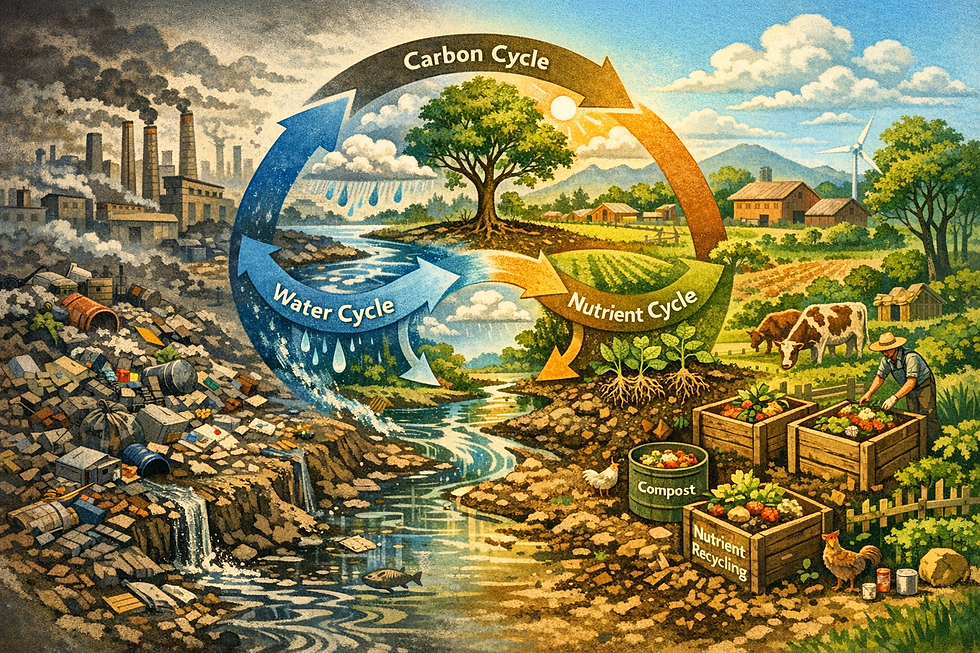
Modern environmental degradation is frequently framed as a crisis of emissions, waste accumulation, or resource depletion. While each of these descriptions captures a dimension of the problem, they obscure a more fundamental structural condition. The dominant industrial economy is organized around linear throughput within a planet that functions through cyclical metabolism. Materials are extracted, concentrated, transformed, and dispersed at velocities and scales that exceed the assimilative and regenerative capacities of living systems. Pollution, in this context, is not incidental. It is systemic.
Waste should therefore be understood not as discarded matter, but as displaced material that has been severed from ecological reintegration. Carbon once geologically stabilized is rapidly mobilized into atmospheric circulation. Nitrogen and phosphorus are industrially synthesized or mined, applied in concentrated form, and frequently lost through volatilization, runoff, and leaching. Synthetic polymers are engineered in chemical configurations for which no widespread biological metabolic pathway exists. These streams accumulate because the system that produces them is not designed to reincorporate them.
Agriculture occupies a uniquely strategic position within this structural condition. It is one of the primary interfaces between human economic activity and biological processes. Yet under industrial organization, agricultural systems often intensify linear throughput. Nutrient cycles are fractured. Livestock are separated from the land base capable of absorbing their manure. Crop residues are treated as waste or are insufficiently reincorporated into soil organic matter. Soil becomes a medium for input delivery rather than a living system with endogenous cycling capacity. The result is nutrient surplus in some regions, nutrient depletion in others, greenhouse gas emissions, water contamination, and declining soil biological integrity.
If waste is structurally produced, mitigation must also be structural. Regenerative systems propose a reorientation of agriculture from throughput to metabolism. Rather than treating waste as an endpoint requiring management, regenerative approaches treat organic material and nutrients as elements of cyclical reintegration. The objective is not simply reduced impact, but restored coherence between human production and ecological function.
Structural Origins of Modern Waste Streams
To understand the potential of regenerative systems, it is necessary to identify the structural origins of contemporary waste streams.
First, carbon waste emerges from the rapid oxidation of fossil carbon stocks combined with land use practices that diminish biological sequestration capacity. Industrial agriculture frequently contributes through soil disturbance, monoculture systems, and the loss of perennial cover, which reduce soil organic carbon and destabilize aggregates that would otherwise store carbon.
Second, nutrient waste results from the decoupling of consumption and soil fertility. Synthetic nitrogen and mined phosphorus are applied in quantities that often exceed plant uptake, leading to nutrient leakage into waterways and atmospheric nitrous oxide emissions. Simultaneously, urban waste systems remove organic matter and nutrients from land and concentrate them in treatment facilities or landfills, breaking the spatial coherence of nutrient cycles.
Third, organic waste streams including food waste, crop residues, and manure are frequently mismanaged. When diverted to landfills or poorly aerated storage systems, these materials generate methane and represent lost fertility potential.
Fourth, material substitution has intensified persistent waste streams. Petroleum based agricultural plastics, synthetic textiles derived from fossil fuels, and chemically intensive inputs contribute to contamination burdens that complicate reintegration and amplify ecological stress.
In each case, the underlying pattern is disconnection. Production is separated from reintegration. Extraction is divorced from regeneration. Feedback is suppressed through spatial and temporal displacement of consequence.
Regenerative Agriculture as Metabolic Realignment
Regenerative agriculture becomes significant because it re establishes metabolic alignment.
Soil is treated as a living system whose biological processes mediate nutrient cycling, carbon stabilization, and water regulation. Practices such as diversified crop rotations, cover cropping, managed grazing, reduced disturbance, and organic matter incorporation are not isolated techniques; they are mechanisms for restoring endogenous cycling capacity.
Carbon that would otherwise oxidize or remain unstable is incorporated into soil organic matter through biological processes. Nutrients are retained within root zones and microbial networks rather than lost to runoff. Livestock, when properly managed, function as agents of nutrient redistribution rather than concentrated pollution sources. Organic residues are reincorporated as compost or mulch, reducing reliance on synthetic inputs.
Importantly, regenerative systems shorten feedback loops. Soil structure visibly responds to management. Water infiltration rates change. Biological diversity shifts. Consequence becomes legible at the scale of the land manager. This feedback re coupling contrasts with industrial systems in which waste can be externalized beyond the site of production.
Such metabolic realignment does not imply a return to pre industrial conditions. Rather, it represents a redesign of agricultural systems so that material flows remain compatible with biological assimilation. The farm becomes a node within a living economy, capable of absorbing and transforming waste streams that would otherwise destabilize climate and ecological systems.
Waste Stream Diversion Through Land Based Systems
One of the most consequential implications of regenerative systems is their capacity to divert waste streams at scale.
Organic municipal waste, when safely processed and free from persistent contaminants, can be transformed into compost that enhances soil fertility and carbon stability. Nutrient recovery from human waste challenges the assumption that sanitation must permanently sever the connection between consumption and soil. When contaminants are controlled upstream, recovered nutrients can close loops that currently depend on energy intensive synthesis and mining.
Similarly, regenerative fiber systems provide pathways for reducing dependence on fossil based synthetics. Fibers such as hemp, flax, and wool, when produced within ecologically regenerative frameworks, offer material streams that remain biodegradable and metabolically compatible with biological systems. Construction materials derived from regenerative forestry and agricultural byproducts further illustrate how land based production can mitigate high emission industrial inputs.
Cemetery waste diversion provides an additional lens. Conventional burial systems often rely on chemically treated materials and sealed vaults that interrupt biological reintegration. Alternative approaches that allow organic matter to return safely to soil restore the fundamental biological logic of death as nutrient cycling. Even here, the principle remains consistent: materials should not be designed in ways that prevent ecological assimilation.
The scalability of such interventions depends on governance, infrastructure, contaminant regulation, and economic incentives. Regenerative systems cannot function coherently if industrial toxins continue to enter nutrient streams. Upstream design reform is therefore inseparable from downstream reintegration.
Toward a Living Economy
A living economy is not defined by sentiment but by structural coherence. It is an economy in which material flows are organized according to the metabolic constraints of the biosphere. Outputs remain compatible with biological assimilation. Nutrient cycles are spatially and temporally reconnected. Feedback is preserved rather than suppressed.
Regenerative agriculture, understood as systemic realignment rather than niche practice, offers one of the few frameworks capable of addressing multiple waste streams simultaneously. It intersects carbon stabilization, nutrient retention, organic waste diversion, material substitution, and hydrological restoration within a single design logic.
The alternative is continued throughput expansion in a finite and metabolically constrained world. That trajectory produces escalating instability because it contradicts the operational principles of the system that sustains life.
If waste is the signal of structural incoherence, then regeneration is the practice of restoring alignment. Agriculture, positioned at the interface between human consumption and ecological process, becomes central to this transition. The question is not whether regenerative systems are idealistic. The question is whether any durable civilization can persist while operating in contradiction to the biological metabolism of the planet it inhabits.
Comments